Building audit-ready evidence for the German Packaging Act and LUCID
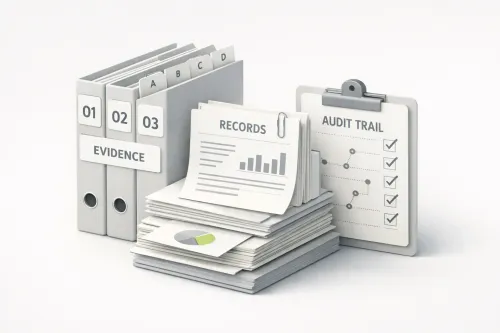
Many businesses only start thinking seriously about evidence for VerpackG and LUCID once a follow-up question already exists. That is when the hectic search begins: which quantities were reported, which version was valid at the time, which brand was affected, which system contract applied in that period, and whether a correction happened later.
The problem is rarely that no documents exist at all. The problem is usually that they were never structured as one connected evidence process. In that case, the business may have documents, but not a calm and explainable story behind them.
This article explains how businesses can build audit-ready evidence for the German Packaging Act and LUCID without turning the process into an artificial bureaucracy project.
Who this is relevant for
This article is especially relevant for companies that are already registered, submit data reports, or work with multiple brands, products, packaging types, and reporting periods. It is also useful for teams asking how they can later explain their packaging-law process in a plausible way.
Typical cases include:
- businesses with several reporting periods or corrections
- online sellers with changing assortments
- importers with several data sources
- small teams where important knowledge is concentrated in a few individuals
What “audit-ready” means in this context
Audit-ready does not mean every document looks formal. It means the business can later explain clearly:
- which packaging data was used
- which quantities were relevant for which period
- which system contract applied
- which reports were submitted to LUCID and to the system operator
- whether and why corrections were made later
The difference matters. Many teams collect evidence, but do not build a clean connection between the underlying pieces. That connection is what later determines whether the process is calmly explainable or not.
Which kinds of evidence are typically important
1. Registration evidence
This includes the LUCID registration itself, the associated company master data, and relevant brand names. These elements form the starting point for the later evidence chain.
2. System contract data
If packaging is subject to system participation, the contract data with the dual system belongs to the evidence set as well. What matters is not only that a contract exists, but also for which period and on which data basis it applied.
3. Quantity and material data
Reported quantities should remain linked to periods, material categories, and the internal packaging logic. If only final totals remain later on, but nobody can explain how they were built, the evidence process is not stable.
4. Report and export evidence
Submitted reports and exports should remain linked to the data state that produced them. Otherwise it later becomes unclear which version was actually reported.
5. Correction history
Corrections are part of real operations. A process becomes audit-ready only when corrections remain explainable as well: what changed, why, when, and on which basis.
VM Insight
In practice, evidence does not usually fail because teams store too little. It fails because too much is stored without clear links. A system contract in one folder, quantities in a spreadsheet, brands in another list, and corrections in an email chain do not automatically form a defensible evidence set. Only structured connection turns documentation into a calm process.
What a robust evidence structure can look like
A good evidence structure does not need to be complicated. But it does need a few clear rules.
1. Define one authoritative data basis
It should be clear which data basis is authoritative for quantities, material logic, packaging categories, and brands. As soon as several competing truths exist, evidence becomes noisy.
2. Separate reporting periods clearly
Every relevant data state should be tied to a specific period. Without that separation, later explanations become unnecessarily hard.
3. Link reports to data states
A submitted report should not sit in isolation. It should remain linked to the underlying data state. Only then does it stay visible which basis the report was built from.
4. Do not overwrite corrections invisibly
If changes simply overwrite earlier values, the explanation path disappears. A cleaner approach keeps a correction logic that does not erase earlier states.
5. Document responsibility
Even a technically clean data state helps only to a point if nobody can say who prepared, checked, or approved it. Audit-ready evidence needs not only data, but also visible process responsibility.
Which mistakes weaken evidence the most
1. There are many documents, but no central structure. That means information has to be reconstructed under time pressure.
2. Earlier states are no longer available. Then it becomes impossible to explain which basis applied to a specific report.
3. Contract data and quantity data do not fit together clearly. That weakens plausibility later.
4. Corrections are documented only informally. Emails and side notes do not replace a traceable correction logic.
5. Responsibility depends too much on one person. If only one individual knows the full chain, the process is not really stable.
Checklist: signs your evidence is becoming more robust
- registration, system contract, and data reporting are linked
- every data state can be assigned to a period
- the reported quantities and material categories remain explainable
- older versions have not simply disappeared
- corrections are documented and traceable
- the team can explain the process logic without relying only on one key person
VM Insight
An audit-ready evidence process does not begin at the last review step. It begins when a team decides that reports, data states, contracts, and corrections belong together. That is where a document collection becomes a process. Verpack Meldung is useful exactly where distributed records need to become one explainable operational workflow.
Conclusion
Audit-ready evidence for VerpackG and LUCID does not mean more bureaucracy for its own sake. It mainly means that a company can later explain its own logic clearly.
If registration, contract data, quantities, reports, and corrections are brought into one traceable structure early enough, operational stress drops significantly. That is exactly why evidence is not a side product of the process, but part of its quality.
FAQ
Is it enough if we simply save all files?
No. Saving files is important, but without structure and connection it often remains unclear later which document belongs to which report or period.
Which evidence is especially important?
Registration data, system contract data, quantity and material data, submitted reports, and traceable corrections.
Why are corrections so important for audit-ready evidence?
Because they show how changes were handled. Without a traceable correction logic, it later becomes difficult to explain why figures differ.
What is the most common evidence mistake?
The most common mistake is not missing documentation, but missing connection between the documents, data states, and reporting periods that already exist.
VM Insight
Where evidence usually breaks down in practice
Evidence rarely disappears completely. More often it is stored in too many places: contract files in one folder, quantities in several spreadsheet versions, brand data in another list, and corrections only in email threads. That is exactly what makes otherwise existing evidence difficult to explain later.
VM Insight
Why a structured evidence process is much calmer later
A process becomes audit-ready not through more documents, but through clearer links between them. When reports, data states, system contracts, and corrections are brought together cleanly, follow-up questions become much easier to answer.
See how the workflow worksSources
- ZSVR: Data reporting · ZSVR
- ZSVR: System participation and data reporting overview · ZSVR
- ZSVR: Registering with the LUCID Packaging Register · ZSVR
- VerpackG § 10 Data reporting obligations · Gesetze im Internet
- VerpackG § 11 Declaration of completeness · Gesetze im Internet
- VerpackG full text · Gesetze im Internet
Keep your VerpackG reporting structured and verifiable
When reports, contracts, data states, and corrections rely on the same data basis, evidence becomes much easier to explain later.