Packaging licence for small businesses in Germany: duties and costs
At a Glance
Key Takeaways
- Small businesses are not automatically exempt from German Packaging Act obligations because of their size.
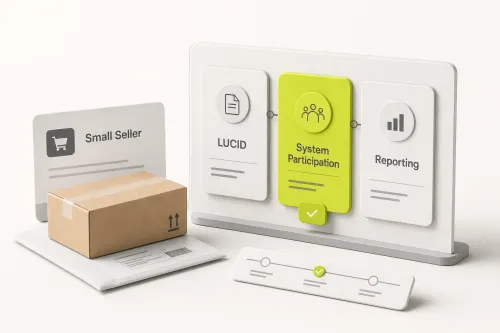
- The search term packaging licence usually points to LUCID registration, system participation and packaging volume reporting.
- LUCID registration is free. Costs usually arise from a system participation agreement where the packaging is subject to system participation.
- For small sellers, shipping boxes, mailing bags, labels, tape and filling material are often the practical starting point.
Quick answer: A small business should not assume that low volume removes all Packaging Act obligations. It should check whether it commercially places packaged goods on the German market. If so, LUCID registration is often the starting point. If the packaging is subject to system participation, a system participation agreement and packaging volume reports may also be required.
The phrase packaging licence sounds like one document. For small online shops, Etsy sellers, Amazon sellers or local businesses that ship goods, the more useful question is which steps belong together: registration, packaging type, system participation, volume reporting and evidence. For changes under the PPWR / EU Packaging Regulation 2026, use the separate overview.
Do small businesses need a packaging licence?
Business size alone does not create a general exemption from German packaging obligations. ZSVR explains that packaging law obligations also apply to small distributors when they act commercially. The practical question is therefore not whether the business looks large, but what role it has in the packaging process.
If a business sells goods in Germany and fills packaging with goods itself, or if it is responsible for imported packaged goods, it should check its role. This is especially common for small online shops that use shipping boxes or mailing bags.
What people mean by packaging licence
Packaging licence is everyday search language, not a precise label for one administrative step. It usually combines three questions:
- Does the business need to register in the LUCID Packaging Register?
- Does the packaging need system participation?
- Do packaging volumes need to be reported to LUCID and to the system operator?
This distinction matters because LUCID registration alone is not enough for packaging that is subject to system participation. At the same time, not every type of packaging triggers the same follow up duties.
Which packaging is most relevant for small sellers?
For small online sellers, the obligation often arises from the shipping process rather than from the size of the catalogue. ZSVR names shipping boxes and bags, as well as labels, adhesive tape and filling materials, as relevant materials in online shipping contexts.
| Situation | What to check | Practical data |
|---|---|---|
| Shipping box or mailing bag | Whether the shipping packaging is subject to system participation | Material type, weight, units |
| Filling material, tape or label | Whether it becomes part of the shipping packaging | Assignment to shipment and material |
| Service packaging | Who carries responsibility in the concrete case | Purchase, use, handover to customers |
| Packaging not subject to system participation | Whether return and evidence duties under section 15 VerpackG are relevant | Volumes, return path, evidence |
The table does not replace a case specific assessment. It shows why even small volumes should be recorded in a structured way.
Packaging licence costs for small businesses
Many searchers want to know what a packaging licence costs. The key distinction is simple: registration in the LUCID Packaging Register is free. A system participation agreement can create costs if the packaging is subject to system participation.
| Step | Cost logic | Why this matters |
|---|---|---|
| LUCID registration | free | It is the starting point, but it does not replace checking the packaging type. |
| Classifying the packaging type | internal effort | Material, weight and use determine which further steps may become relevant. |
| System participation | typically cost relevant | Costs depend on material groups, quantities and the conditions of the chosen system operator. |
| Volume reporting | no separate LUCID fee | The figures need to match LUCID, the system operator and internal evidence. |
| Keeping evidence | organisational effort | With several sales channels, invoices, quantity basis and reported data should remain traceable and reviewable. |
For small businesses, the difficult part is often not LUCID registration itself, but preparing packaging data cleanly. Sellers using boxes, mailing bags, filling material, labels or several sales channels should record the quantity basis in a structured way early.
What is free?
LUCID registration itself is free according to ZSVR. It is still only one step. It does not mean the packaging has already been financially participated in a recycling system or that future volume reports are prepared.
Which costs can arise?
Costs typically arise from the system participation agreement. The actual amount depends on materials, weights, quantities and the conditions of the chosen system. Without current provider data, an article should not name fixed market prices.
Which data should small sellers prepare?
For costs, system participation and reports, small sellers need a reliable material and quantity basis. This includes packaging type, material group, weight per packaging component, expected or actual units and assignment to products or shipping methods.
Step by step: what small sellers should do
- Check the role: Are packaged goods being commercially placed on the German market?
- Check LUCID registration: If registration is required, master data, brands and packaging types need to be correct.
- Classify packaging types: Shipping, service, sales and other packaging types should not be mixed together.
- Clarify system participation: Packaging subject to system participation requires an agreement with a system operator.
- Report volumes consistently: The data should match LUCID, the system operator, internal lists and evidence.
What Verpack Meldung supports and what it does not
Verpack Meldung does not sell system participation agreements and does not replace a legal assessment. The software helps businesses structure packaging data, material groups, volume reports and evidence in a traceable process.
This is useful for small businesses because a simple spreadsheet may work at the beginning, but several products, shipping methods, systems and corrections can quickly become connected. Then it matters that numbers are not only calculated once, but can be explained again later.
Common mistakes small businesses make
- Treating LUCID registration as if it completed all obligations.
- Forgetting shipping materials such as filling material or adhesive tape.
- Looking at costs only as a provider price, not as a result of clean quantity and material data.
- Preparing system participation and LUCID reports with different numbers.
- Keeping evidence scattered across emails, invoices and spreadsheets.
Frequently asked questions
Do small businesses need a packaging licence?
They do not need a special licence because of their small business status. They need to check whether LUCID registration, system participation and volume reporting are relevant for their packaging.
Is there a minimum quantity below which the Packaging Act does not apply?
ZSVR does not describe a general exemption for commercially active small distributors only because volumes are low. The concrete duty depends on role and packaging type.
What does a packaging licence cost for a small business?
LUCID registration is free. Costs can arise from a system participation agreement. They depend on material, weight, quantity and provider conditions.
What does licensing packaging mean?
In everyday language, the phrase usually means participating certain packaging with a system operator. Small sellers should not confuse this step with LUCID registration. Depending on the packaging type, registration, system participation and volume reporting can belong to the same process.
Is LUCID registration enough?
Not always. If the packaging is subject to system participation, system participation and matching volume reports also need to be considered.
Do mailing bags, boxes, tape and filling material count?
These materials can be relevant in shipping. What matters is how they are used in the concrete shipping process and which packaging type results from that use.
Does Verpack Meldung sell a system participation agreement?
No. Verpack Meldung supports the data and reporting process, but it does not sell system participation agreements.
Conclusion
Small businesses should not treat packaging licence as one purchase. The practical sequence is what matters: check the role, clarify LUCID registration, record packaging types, arrange system participation where required, report volumes consistently and keep evidence. A structured basis reduces later corrections and misunderstandings.
Sources
- ZSVR: Producer under German packaging law · ZSVR
- ZSVR: Registering with the LUCID Packaging Register · ZSVR
- ZSVR: Mail order companies and online retailers · ZSVR
- German Packaging Act section 15 · Gesetze im Internet
Keep your VerpackG reporting structured and verifiable
If packaging types, quantities and reporting data are structured properly, later LUCID-related work becomes far easier to manage.