LUCID quantity reporting: report types and technical deadlines
At a Glance
Key Takeaways
- LUCID distinguishes four quantity reporting types: the initial planned quantity report (
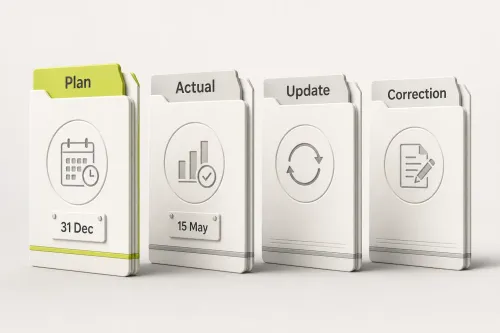
Initiale Planmengenmeldung), the annual final quantity report (Jahresabschlussmengenmeldung), the in-year quantity report (Unterjährige Mengenmeldung), and the subsequent quantity report (Nachtragsmengenmeldung). - The dates 31 December and 15 May are technical deadlines for specific reporting types in the LUCID interface.
- If quantities still need to be reported or corrected after those dates, a different reporting type must be used instead.
- Reporting frequency depends on what was contractually agreed with the dual system.
Introduction
If you report quantities in LUCID for packaging subject to system participation, it is not enough to know only the quantities themselves. It is just as important to know which reporting type you are using and how long that reporting type remains technically available in the interface.
For LUCID quantity reporting, the ZSVR distinguishes four reporting types. They do not serve the same purpose. Some are used for planned quantities, others for actual quantities, and others for later corrections. In practice, that makes two questions especially important: which report type is the right one, and how should the technical deadlines attached to it be understood?
In this article, we explain which reporting types exist, when each one is used, and how to interpret the dates 31 December and 15 May.
Which reporting types exist in LUCID
The official ZSVR page lists four quantity reporting types:
| Reporting type | When it is used | What it relates to |
|---|---|---|
initial planned quantity report (Initiale Planmengenmeldung) |
when you report planned quantities for the following calendar year | future quantities |
annual final quantity report (Jahresabschlussmengenmeldung) |
when you report actual quantities for the previous calendar year | previous year |
in-year quantity report (Unterjährige Mengenmeldung) |
when you update previously reported planned quantities during the current year | current year |
subsequent quantity report (Nachtragsmengenmeldung) |
when you subsequently correct already reported actual quantities for the previous year | previous year |
The simplest rule is this: the correct reporting type depends on whether you are reporting a plan, actual quantities, or a correction.
What the dates 31 December and 15 May mean
The ZSVR page highlights two dates in particular. They should be read as technical deadlines for specific reporting types in LUCID, not as universal statutory deadlines for every obligation connected with quantity reporting.
31 December
Until 31 December, the initial planned quantity report is technically available for the following calendar year. After that date, planned quantities for that year are no longer reported through the initial planned quantity report, but through the in-year quantity report.
15 May
Until 15 May, the annual final quantity report is technically available for the previous calendar year. This report is used for actual quantities for the previous year. After that date, corrections or additional reports for that period are no longer made through the annual final quantity report, but through the subsequent quantity report.
Important: These two dates describe the availability of specific reporting types in the LUCID interface. In this article, we therefore treat them as technical deadlines for the relevant report types.
How to choose the correct reporting type
In practice, the most useful starting point is to ask what exactly is being reported.
- If you are reporting planned quantities for the following year, use the initial planned quantity report.
- If you are reporting actual quantities for the previous year, use the annual final quantity report.
- If you are changing a previously reported plan during the current year, use the in-year quantity report.
- If you are subsequently correcting already reported actual quantities for the previous year, use the subsequent quantity report.
This distinction helps avoid a common misunderstanding: there is not just a single quantity report. LUCID distinguishes several reporting situations and uses a separate reporting type for each one.
How corrections work
Corrections depend on whether you are correcting planned quantities or actual quantities.
If you need to change previously reported planned quantities during the current year, the in-year quantity report is used. This updates the quantity recorded for that year.
If you need to correct already reported actual quantities after year-end, the subsequent quantity report is used. It serves to correct data for the previous year.
For example, if you reported 100 kg of a material type in the annual final quantity report and later determine that the actual quantity was 120 kg, the correction is made through a subsequent quantity report for that difference.
How often quantities are reported
Reporting frequency depends on what was contractually agreed with the dual system. In practice, this may mean monthly, quarterly, or annual reporting.
For the content of the report, what matters is that the data matches what was reported to the dual system and that it is recorded in LUCID for the same period, the same system, and the same quantities.
Which data a report contains
Regardless of the reporting type, LUCID records:
- the period the report relates to
- the dual system the report relates to
- the material types and corresponding masses
That is why it is useful to check before reporting whether the period, the selected system, and the quantities are aligned with each other.
Conclusion
LUCID quantity reporting is not a single action, but a set of different reporting types used depending on the type of data and when it is reported.
For day-to-day operations, the most important distinction is between planned quantities, actual quantities, and later corrections. It is equally important to interpret 31 December and 15 May correctly, namely as technical deadlines for specific reporting types in LUCID.
The most practical closing rule is this: data reported to the dual system must also be recorded in LUCID without delay for the same period, the same system, and the same quantities.
VM Insight
Why a structured quantity-reporting workflow reduces operational friction
When reporting types, periods, systems, and quantities are documented in one structured flow, corrections and follow-up checks are easier to track than across scattered sheets or ad hoc notes.
See how the workflow works →Sources
- ZSVR, Datenmeldung · ZSVR
- ZSVR, Datenmeldung der Systeme · ZSVR
- ZSVR Factsheet Datenmeldung (PDF) · ZSVR
- ZSVR Anleitung Datenmeldeprozess (PDF) · ZSVR
Keep your VerpackG reporting structured and verifiable
See how packaging data, quantities, corrections, and reporting periods are handled in one clear workflow.