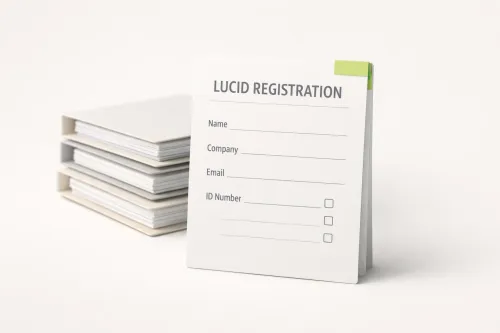
LUCID registration step by step
In brief
Key takeaways
- LUCID registration only works cleanly if your role, brand names, packaging types, and company master data are clarified before the first login.
- Registration and system participation are connected but separate steps and should be handled together in the workflow.
- If you document the registration number, packaging data, and internal ownership immediately, later reporting becomes far more stable.
For many companies, LUCID registration is the first visible step in German packaging compliance. In practice, however, the registration form itself is rarely the hardest part. The real friction usually appears where responsibilities are unclear, where packaging data is incomplete, or where no one can say with confidence which brand, packaging type, or sales flow actually belongs in the process. That is why it makes sense to treat registration as the beginning of a structured workflow, not as a one-off task.
This guide explains when registration matters, which information should be prepared before you start, how the process works in practical terms, and where companies most often lose time. The claims in this article are based on official sources from the Central Agency Packaging Register and on the Packaging Act itself.
Who this guide is for
This article is useful if your company sells products into Germany or places packaged goods on the German market for the first time and you are unsure whether you need to register in LUCID. That includes ecommerce sellers, brand owners, importers, small manufacturers, founders, and operational teams who suddenly have to answer marketplace or compliance questions.
It is important to remember that not every business is affected for exactly the same reason. The legal framework distinguishes between roles and packaging constellations. In practical work, the question is not only what your company is called, but also who actually places which packaging on the German market first.
What LUCID is
LUCID is the packaging register operated by the Central Agency Packaging Register. Its purpose is to identify the responsible producer or obligated company in a transparent way. Under section 9 of the Packaging Act, manufacturers must register before placing system-participation packaging on the market. The register is therefore not a symbolic database. It is one of the core public compliance steps in the German system.
In operational terms, that means companies should not wait until a marketplace requests a number or until an external deadline forces a rushed decision. If registration is relevant in your case, it belongs early in the process.
When registration usually becomes relevant
The official ZSVR guidance on who must register makes it clear that the answer depends on your market role. Typical constellations include brand owners, manufacturers, or importers who place packaged goods on the German market for the first time. Online sellers often find this confusing because several parties can be involved in the same supply chain.
A practical working rule is this: if your packaging ends up with German end consumers and you are the party that first places that packaging on the German market in a relevant role, you should treat registration as a serious compliance question. Where there is uncertainty, the next step is not guesswork but documented clarification of the supply chain, product ownership, and packaging responsibility.
What to prepare before you register
The registration process is much smoother when the master data has already been cleaned up. That typically means company details, contact person, brand names, relevant packaging types, and a clear understanding of whether system participation is also required. The official registration information from the ZSVR also notes that registration should be completed within seven days after the first login. That is not a good moment to start hunting for missing ownership or inconsistent company data.
A useful preparation list includes:
- the exact legal company name and legal form
- a clearly responsible contact person
- the brand names under which relevant packaging appears on the market
- the packaging types that are actually relevant for your products and sales flow
- a documented understanding of whether you are acting as manufacturer, importer, or in another obligated role
- a parallel check of whether section 7 system participation applies to your packaging
Where these basics are not clear, registration often still gets completed somehow, but later reporting and internal control become much harder than they need to be.
LUCID registration step by step
Step 1: Clarify whether your role is in scope. Before you enter data into the register, use the official ZSVR guidance to document why you believe registration applies or does not apply. This first step prevents later confusion and creates a basis for internal accountability.
Step 2: Create your login. Use the registration access provided by the Central Agency Packaging Register. Once you have started, plan to complete the process quickly instead of leaving it half-finished.
Step 3: Enter company master data carefully. Use legally and operationally consistent company information. Small inconsistencies at this stage often create later friction when marketplaces, contracts, and register data no longer line up.
Step 4: Provide brands and relevant packaging types. The registration process requires specific information about brands and packaging types. This is where weak internal data management often becomes visible. If different teams use different brand naming or if shipping packaging has never been documented properly, mistakes start here.
Step 5: Finish the registration and document the registration number. Once the process is completed, keep the LUCID registration number in a place that is accessible to the operational and compliance teams. That number becomes relevant later for coordination with the dual system and with marketplaces.
Step 6: Handle system participation separately where required. Registration is not the same as concluding a contract with a dual system. If your packaging is subject to system participation, that obligation follows from section 7 of the Packaging Act and must be handled as its own step.
Step 7: Put the internal workflow in place immediately after registration. Decide who owns company master data, who tracks brand or packaging changes, and how later quantities will be prepared. This is what turns registration from a one-off administrative action into a repeatable compliance workflow.
Where companies usually get stuck
Most delays do not happen because the interface is technically difficult. They happen because important decisions were never made before the form was opened. Common examples include conflicting brand names across teams, uncertainty about whether the importer or brand owner should register, and incomplete visibility into the actual packaging that reaches German consumers.
Another recurring problem is the assumption that registration closes the topic. In reality, a company may have a valid registration number but still be unable to explain later which packaging types were included, which brands are covered, or how later data was derived. That is where a registration issue turns into a broader reporting issue.
Checklist: what must still be true after registration
- the LUCID number is documented centrally
- company and brand master data are internally consistent
- system participation has been checked separately
- packaging data can be maintained by product, packaging type, or reporting unit
- someone clearly owns later data reporting responsibilities
- changes in products, brands, or packaging are documented over time
- later numbers can be reconciled between LUCID, the dual system, and internal records
Common mistakes to avoid
A classic mistake is separating registration from the data environment that comes afterward. The register may be correct on paper, while the operational teams keep using different brand names, different packaging assumptions, and different reporting lists. Another frequent mistake is focusing only on product packaging and forgetting the shipping packaging that will later matter in quantities and plausibility checks.
It is also risky to start the process too late. When teams only react after a marketplace or partner asks for proof, they often compress several decisions into a very short time window. A calmer and more robust approach is to treat registration, system participation, and later reporting readiness as one connected chain.
Conclusion
LUCID registration is not just a formality. It is the visible start of a compliant and explainable VerpackG workflow. Companies that clarify their role early, prepare company and brand data properly, and connect registration to later packaging reporting are much better positioned for the steps that follow.
If you do not isolate registration from the rest of your process, it becomes easier to keep the later reporting work structured and verifiable.
FAQ
Do I need to register if my company is not based in Germany?
Your registered office alone does not decide the issue. What matters is your role in placing the packaging on the German market. If you are the party first placing relevant packaging on the market in Germany, registration may still be required.
Is LUCID registration enough by itself?
No. Where system-participation packaging is involved, section 7 of the Packaging Act must also be considered. Registration and system participation belong together, but they are not the same obligation.
When should registration be handled in practice?
Ideally before external proof is requested and before affected packaging is placed on the market. The ZSVR also notes that registration should be completed within seven days after the first login.
Which internal data should be ready before starting?
At minimum: company master data, responsible contact details, brand names, relevant packaging types, and a documented view of your role in the supply chain. The cleaner these basics are, the more stable the later process becomes.
VM Insight
VM Insight
The real problem usually starts before LUCID. Teams often do not have consistent ownership of brand names, company master data, import responsibility, or packaging flows. The register only makes those gaps visible.
See the workflowVM Insight
VM Insight
A clean registration is only useful if the same company, brand, and packaging data can be reused later in reporting. A structured workflow reduces not only registration errors, but also later mismatches between LUCID, the dual system, and internal files.
Explore the reporting processSources
- ZSVR: All information about registration · Central Agency Packaging Register
- ZSVR: Do I need to register in LUCID? · Central Agency Packaging Register
- Packaging Act § 9 Registration · Gesetze im Internet
- Packaging Act § 7 System participation · Gesetze im Internet
Keep your VerpackG reporting structured and verifiable
If you do not want registration and later reporting to stay an ad hoc exercise, start with a structured workflow.