Packaging Data Reporting for Beginners: What Goes Into Your LUCID Quantity Report and How It Connects to Your System Operator
Key Takeaways
Key Takeaways
- The packaging data report is the regular quantity submission a business files in LUCID after registering and signing a system participation contract.
- The report links packaging quantities, material categories, the system operator, and the reporting period into a single structured submission.
- Reporting frequency (annual, quarterly, monthly) depends on your contract with the system operator - there is no one-size-fits-all rule.
- Quantities reported in LUCID must match the quantities reported to your system operator for the same period.
After registering in LUCID and signing a system participation contract, the third step is the data report - what the Central Agency Packaging Register (ZSVR) officially calls Datenmeldung. For many businesses, this is the moment an abstract obligation becomes a concrete task.
This article explains what the packaging data report is, what data goes into it, and how it connects to your system operator. It is not a walkthrough of the LUCID interface - it is a conceptual guide for businesses preparing their first report and wanting to understand what lies ahead.
Where the Data Report Fits in the Overall Process
The ZSVR describes the compliance process in three steps: register, participate, report. The data report is the third step. It does not stand alone - it builds on the first two.
First, your business must be registered in LUCID. Without registration, there is no access to the reporting function.
Second, your business needs an active system participation contract for the packaging that requires system participation. This contract defines which quantities, for which period, and how frequently your business reports.
Only then comes the data report - the submission that connects these two elements. This is why simply asking "when is the report due?" is not enough. The answer depends on your contract.
What Goes Into the Data Report
The data report is not a single number. It is a structured submission that links several elements.
Packaging quantities. Your business reports the mass of packaging (usually in kilograms) placed on the German market during the relevant reporting period.
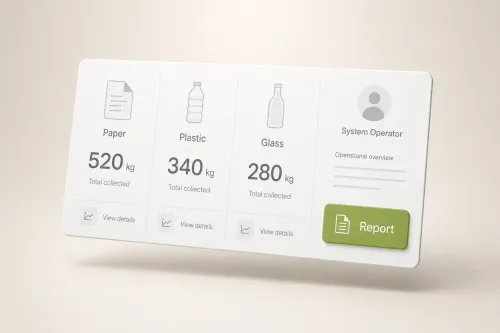
Material categories. Quantities are not reported as one total. They are broken down by material category: glass, paper/cardboard, plastic, aluminium, and others. These categories are standardized and used both in LUCID reporting and in communication with system operators.
System operator. Each report is linked to the specific system operator your business has a contract with. If you use multiple system operators, each one requires associated data.
Reporting period. The report covers a defined time period. This period is set in your contract with the system operator and can be annual, quarterly, or monthly.
Reporting Frequency Depends on Your Contract
Many businesses expect a simple answer like "once a year" or "by March 31st." In practice, there is no universal rule.
Reporting frequency is defined in your contract with the system operator. Some contracts require annual reporting, others quarterly, and some monthly. Two businesses with similar obligations can have completely different reporting rhythms, depending on how they structured their system participation contract.
This is why the question "when is my report due?" is best directed to your system operator. Your contract sets both the rhythm and the deadlines. The ZSVR expects data to be reported according to that contract but does not prescribe one fixed date for everyone.
Why the Quantities Must Match
The data report is not an independent document. It relies on data already reported to your system operator.
Under the ZSVR framework, quantities reported in LUCID must materially match the quantities reported to your system operator for the same period. If your business reported 500 kg of paper packaging to your system operator for a given quarter, the LUCID report for that same period should show the same figure for that material category.
This is not just a formality. It is the mechanism that allows the ZSVR to check consistency between what your business reports in the register and what it has already reported to its system operator. Discrepancies can lead to follow-up questions.
Therefore, before submitting your data report, it is useful to compare:
- the quantities already reported to your system operator,
- your internal records of packaging quantities,
- what you plan to report in LUCID.
If there are differences, it is better to resolve them before submitting rather than after.
What Happens After You Submit
Once your business files the data report, the data is recorded in the LUCID register. The ZSVR can check consistency between your LUCID report, your registration data, and your reports to system operators.
Corrections are possible. If your business later discovers an error, you can submit a correction. However, each correction must be consistent - if the LUCID report changes, data with the system operator should also be reviewed.
Beyond the data report itself, some businesses face an additional requirement: the declaration of completeness (Vollstaendigkeitserklaerung). The ZSVR lists this as a separate item. It is an additional document confirming that the reported data is complete. Which businesses are required to submit it and when depends on specific criteria.
Verpack Meldung Insight
The data report rewards businesses that keep structured records. When products, packaging, materials, quantities, and periods are linked from the start, reporting is not a reconstruction exercise from scattered sources - it is the final step in a logical chain. Businesses that only compile data at the end of the period typically spend more time reconciling than reporting.
Conclusion
The packaging data report is not a complicated concept. It is the submission that connects your LUCID registration with your system operator contract. What matters is understanding that there is no single universal deadline for everyone. Reporting frequency is defined in your contract with your system operator. The best source for your specific deadlines is therefore that contract.
Sources
Keep your VerpackG reporting structured and verifiable
Structured data makes LUCID reporting and system operator reconciliation easier.